
Hollow Temples
One of the earliest places the face loses volume, and one of the most under-treated. Restoring the temples reframes the whole upper face.
Sculptra isn't a filler. It's poly-L-lactic acid — a scaffold that prompts your own body to rebuild collagen over three to six months. Nothing dramatic happens on treatment day. What happens instead is that over the following months, people start telling you that you look well, without being able to say why.

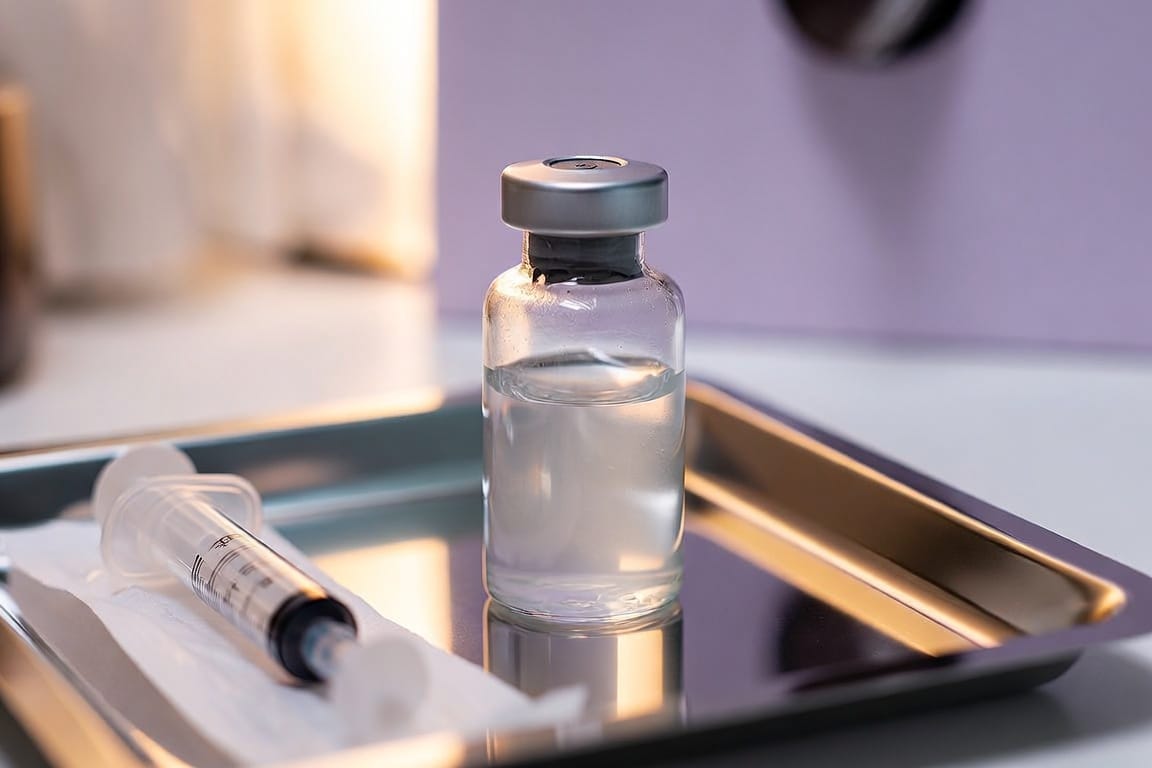
Sculptra is an injectable made of poly-L-lactic acid — a biocompatible synthetic that has been used in dissolvable surgical sutures for decades. It works on a completely different principle from filler. Instead of occupying space, the PLLA microparticles act as a scaffold that signals your fibroblasts to lay down new collagen. The particles themselves gradually break down and are absorbed, leaving behind the tissue your own body built.
That mechanism explains everything else about how Sculptra behaves. It's why nothing much happens on treatment day. It's why results take months. And it's why the change tends to read as you, rested rather than as a treated feature.
It also explains what Sculptra is not good at. If you want fuller lips or a sharper chin next week, this is the wrong product entirely — hyaluronic acid filler does that job better and does it immediately.
At Chic Derm & Aesthetics in Allen, Sculptra is injected by Faseeha Raza, PA-C, a board-certified Physician Associate, under the supervision of Dr. Muhammad Raza, MD.
These get discussed as if they were the same category. They aren't. Confusing them is the single most common reason patients end up disappointed with one or the other.
The reversibility difference is the one to sit with. If you dislike a hyaluronic acid result, it can be dissolved in a single appointment. Sculptra cannot — it has to metabolize on its own timeline. That isn't a reason to avoid it, but it is the reason conservative dosing and correct technique matter more here than with almost any other injectable. We'd rather under-treat and add at your next session than over-treat something we can't take back. Comparing your options? See our dermal filler guide or PDO thread lifts.
Sculptra suits broad, gradual volume loss — the kind that makes a face look tired or drawn without any single feature being obviously the problem.
One of the earliest places the face loses volume, and one of the most under-treated. Restoring the temples reframes the whole upper face.
As the cheek fat pads descend and shrink, the midface flattens and everything below it follows. Rebuilding support here lifts the lower face indirectly.
An FDA-approved indication for Sculptra. Rather than filling the fold directly, restoring midface support softens what created it.
Adds diffuse structural support along the jaw where laxity and volume loss combine, for definition that doesn't look built.
Because the mechanism is collagen production, many patients notice skin feels firmer and thicker in treated areas, independent of the volume change.
When nothing is individually wrong but the overall impression has changed, Sculptra addresses that better than treating one feature at a time.
The most important thing to understand before booking: you will look the same when you leave. Patients who aren't told this often think the treatment failed. Here's the honest arc.
You may look slightly fuller leaving the clinic — that's the sterile water the product is mixed with, not the result. It's temporary. Some swelling, redness or bruising at injection points is normal.
Swelling settles and you return to your baseline appearance. This is the part patients find unnerving if nobody warned them. Nothing has gone wrong — the collagen process is only beginning.
The first genuine change. Usually noticed in photographs before the mirror, and often noticed by other people before you notice it yourself.
Collagen production is well underway across treated areas. Most patients have completed their series by now and the cumulative effect becomes clear.
Full result. This is the point at which your provider assesses whether an additional vial would improve things — not before.
Results commonly hold for two years or more. Aging continues underneath, so periodic maintenance sustains what you built.
Sculptra is one of the few injectables where what you do afterward genuinely affects the outcome. The standard guidance is simple and worth following exactly.
Massage each treated area for a full five minutes. Firm, thorough pressure — not a quick rub in passing.
Spread across the day rather than clustered together. Setting phone reminders is the usual way patients keep to it.
Consistency across the full five days matters more than intensity on any one of them.
Why it matters: massage helps distribute the PLLA particles evenly through the tissue. Uneven distribution is the main contributor to small nodules forming under the skin — the complication Sculptra is best known for. Five days of diligence is the single biggest thing you control.
Also for the first week: apply ice for swelling in the first 24 hours, skip strenuous exercise and saunas for two to three days, avoid significant sun exposure, and postpone facials or other facial treatments for about two weeks. Your provider gives you written instructions to take home.
Sculptra is a good product used well and a frustrating one used carelessly. Here's what we'd want you to know before you agreed to it.
Generalized volume loss across the midface or temples; you're comfortable waiting months for the result; you'd rather nobody could point to what changed; you want something that outlasts a typical filler.
A history of keloid scarring, certain autoimmune conditions, or previous nodules from a biostimulator. None are automatic disqualifiers, but they change the plan and sometimes the answer.
You want lips, a defined chin or an immediate change; you have an event in under six months; you want something reversible; there's an active skin infection in the treatment area.
On nodules, plainly: the risk most associated with Sculptra is small bumps or papules forming under the skin. It's uncommon, and it's strongly linked to three avoidable things — product injected too superficially, inadequate reconstitution or hydration time before use, and skipped post-treatment massage. We hydrate the product well in advance of your appointment rather than mixing it on the spot, inject at the correct depth, and make sure you leave knowing exactly how to massage. Ask any injector how far ahead they reconstitute; it's a fair question and a revealing one.
Sculptra is priced per vial, and most plans use one to two vials per session across a series. Because of that, we quote the whole series at consultation rather than a single-session figure — a per-session price tells you very little on its own.
How many vials you need depends on how much volume loss is being addressed. More correction means more vials, and we'll tell you the realistic number before you commit.
Two to three sessions is typical. Budgeting for the series rather than the first appointment is the right way to think about it. See the price menu →
Membership savings plus CareCredit & Cherry financing — useful here, since the cost is spread across a series.
General information, not a quote. Call 469-466-2727 for current pricing.
With a product that can't be reversed, who holds the syringe matters more than usual. Yours is a board-certified Physician Associate working under the direction of Dr. Muhammad Raza, MD.

Faseeha Raza is a board-certified and licensed Physician Associate practicing Dermatology and Facial Aesthetics. Her approach with biostimulators is deliberately conservative — build gradually across sessions, assess at six months, and add only if the result calls for it. With a product that can't be dissolved, that restraint is the point. She serves as Chair of the SDPA Distance CME Committee.
Book with Faseeha →
Dr. Muhammad Raza is an Internal Medicine, Pulmonary, Critical Care and Sleep Medicine board-certified physician practicing since 2002. As Medical Director, he establishes and oversees the clinical protocols behind every injectable treatment performed here, including product handling and reconstitution standards.
More about our team →Medically reviewed by Dr. Muhammad Raza, MD · Last reviewed September 2026. This page is general education, not medical advice. Sculptra requires evaluation by a licensed provider; candidacy, results and recovery vary by individual.
Our Allen clinic sits just off Highway 75 on West Exchange Parkway — a short drive from Frisco, Plano, McKinney and the rest of Collin County.
Exploring your options? Dermal & lip fillers · PDO thread lift · Med spa in Allen
"I have been a client for the past few months now and Faseeha is truly gifted. I've never had an aesthetician that made me feel so cared for…"
"My results were amazing. She educated me throughout the process and made me feel comfortable every step of the way…"
"She made me feel incredibly comfortable and walked me through every step of the treatment…"
Note: swap in a Sculptra-specific Google review when one is available.
Sculptra is an injectable made of poly-L-lactic acid, a biocompatible synthetic used in dissolvable sutures for decades. It's not a filler. Rather than adding volume directly, the PLLA particles act as a scaffold that prompts your own fibroblasts to produce new collagen over the following months. The particles then break down and are absorbed, leaving the collagen your body built.
No — it's a collagen stimulator, or biostimulator. A hyaluronic acid filler is a gel that occupies space the moment it's injected, so you see the result immediately. Sculptra produces no meaningful immediate volume; what you see on treatment day is temporary swelling from the fluid it's mixed with, which settles within a day or two. The real change appears gradually as collagen builds.
Most patients begin noticing change around six to eight weeks after the first session, with results building through three to six months. Because it's gradual, the change tends to read as looking well rather than as having had something done. Patience is genuinely part of the treatment. See the full timeline →
A series of two to three sessions spaced four to six weeks apart is typical, though the number depends on how much volume loss is being addressed and your age. Your provider assesses this at consultation and adjusts as your collagen response becomes visible between sessions.
Studies have shown results lasting up to two years or more after a full series — longer than most hyaluronic acid fillers. Because the result is your own collagen, longevity depends on your individual biology and continued aging. Periodic maintenance sessions help sustain it.
No, and it's the most important difference between Sculptra and hyaluronic acid fillers. HA fillers can be dissolved with hyaluronidase if you dislike the result. Sculptra cannot be dissolved or reversed — it has to metabolize naturally over time. That's precisely why conservative dosing, correct technique and an experienced injector matter so much with this product.
Massage distributes the PLLA particles evenly through the tissue and reduces the likelihood of small nodules forming. The standard guidance is the rule of fives: five minutes per area, five times a day, for five days. It's a small commitment that meaningfully affects your outcome. Full aftercare →
Common temporary effects include swelling, redness, tenderness and bruising at injection sites. The most discussed specific risk is small nodules or papules forming under the skin — linked to product placed too superficially, inadequate reconstitution, or skipped massage. Choosing a trained injector who properly hydrates the product and places it at the correct depth substantially reduces that risk. Sculptra is generally avoided with a history of keloids or certain autoimmune conditions.
Sculptra is priced per vial, and most plans use one to two vials per session across two to three sessions. Because pricing depends on how many vials your plan needs, we give you the full cost of the series at consultation rather than a per-session figure alone. Call 469-466-2727 for current pricing, plus membership savings and CareCredit & Cherry financing.
They solve different problems. If you want a defined change to a specific feature, visible immediately, with the option to reverse it, hyaluronic acid filler is the better tool. If you have generalized volume loss across the midface and temples and want gradual, overall restoration that lasts longer, Sculptra suits that better. Many patients eventually use both — Sculptra for foundation, filler for definition.
Book a complimentary consultation in Allen. We'll assess where you've lost volume, tell you honestly whether a biostimulator or a filler is the better tool for your goal, and map out the full series and cost before you commit to anything.
On West Exchange Parkway, minutes from Highway 75 — convenient from Frisco, Plano, McKinney and across Collin County.