Botox vs. Juvéderm: Which Treatment Is Right for You?
Understand the differences between wrinkle-relaxing injections and hyaluronic acid fillers—and which approach may better match your facial rejuvenation goals.
Have you started noticing forehead lines, wrinkles around your eyes, deeper smile lines, or a loss of fullness in your cheeks? These changes are a natural part of aging, but modern aesthetic treatments offer several ways to soften their appearance and restore facial balance.
Two popular options are Botox and Juvéderm. Both are injectable treatments used in facial rejuvenation, but they work in very different ways. Botox helps relax the facial muscles responsible for expression-related wrinkles, while Juvéderm uses hyaluronic acid-based fillers to restore volume, enhance facial contours, and soften certain lines.
So, when comparing Botox vs. Juvéderm, which one should you choose? The answer depends on what you want to improve. Botox is generally used for wrinkles created by repeated muscle movement, while Juvéderm is used to add volume and support in selected areas. Understanding this distinction can help you have a more informed conversation with your aesthetic provider.
Quick Answer: Botox vs. Juvéderm
Botox temporarily relaxes targeted facial muscles to soften dynamic wrinkles, such as forehead lines, frown lines, and crow’s feet. Juvéderm adds hyaluronic acid gel beneath the skin to restore volume, enhance contours, and soften certain folds. They are not interchangeable; the right option depends on the concern being treated.
What Is the Difference Between Botox and Juvéderm?
The biggest difference between Botox and Juvéderm is how they work and the concerns they are designed to address.
Botox is a neuromodulator, meaning it temporarily reduces the activity of specific facial muscles. It is commonly used to soften wrinkles that appear when you smile, frown, or raise your eyebrows.
Juvéderm is a collection of hyaluronic acid (HA) dermal fillers designed to add volume beneath the skin. Depending on the formulation, Juvéderm can enhance lips, restore fullness in the cheeks, improve facial contours, and soften certain lines around the mouth.
According to the Cleveland Clinic’s explanation of Botox and facial fillers, neuromodulators target muscle activity, while dermal fillers add volume to selected areas of the face.
In simple terms:
- Botox works on the muscles that contribute to expression lines.
- Juvéderm adds volume and support beneath the skin.
- Botox helps soften wrinkles caused by repeated muscle movement.
- Juvéderm helps address volume loss, facial contours, and selected folds or lines.
How Does Botox Work?
Facial expressions involve repeated muscle movements. Over time, frequently contracting certain muscles can contribute to wrinkles, particularly across the forehead, between the eyebrows, and around the outer corners of the eyes.
Botox contains a purified form of botulinum toxin type A. When injected in carefully selected amounts, it temporarily blocks nerve signals that tell targeted muscles to contract.
Why does this matter? As the treated muscles relax, the skin above them appears smoother. This makes Botox particularly useful for dynamic wrinkles—lines that become more noticeable when you make facial expressions.
The Mayo Clinic’s guide to Botox injections explains that Botox blocks chemical signals responsible for muscle contractions. The treatment is also used for certain medical conditions, although its cosmetic application is particularly well known for softening facial wrinkles.
What Concerns Can Botox Address?
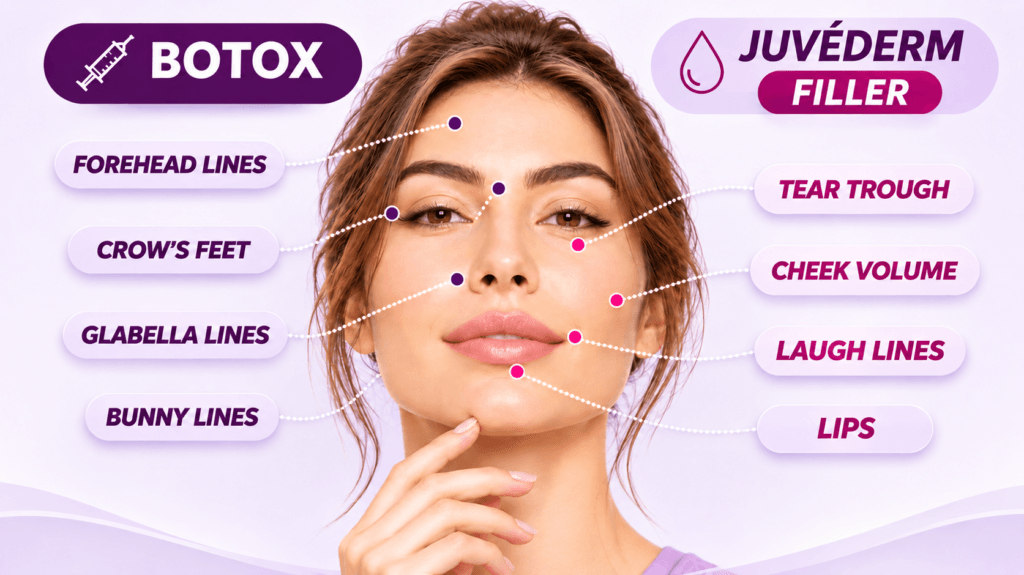
Depending on the treatment plan and individual suitability, Botox may be used to improve:
- Forehead lines
- Frown lines between the eyebrows
- Crow’s feet around the eyes
- Selected expression-related wrinkles
- Certain other concerns for which botulinum toxin treatment is appropriate
Important distinction: Botox does not restore lost facial volume or fill hollow areas. Its primary cosmetic purpose is to reduce the muscle activity contributing to particular wrinkles.
When Will You See Botox Results?
Botox results do not appear immediately. Many people begin noticing changes within one to three days, while the full effect may take a week or longer. According to the Mayo Clinic, results generally last around three to four months, although the duration can vary depending on the individual and the condition being treated.
What Is Juvéderm and How Does It Work?
Juvéderm is a family of injectable dermal fillers made with a modified form of hyaluronic acid (HA).
Hyaluronic acid is naturally present in the body and helps tissues retain moisture. In dermal fillers, specially formulated HA gel is placed beneath the skin to add volume, improve facial contours, and soften selected lines.
Unlike Botox, Juvéderm does not work by relaxing facial muscles. Instead, it provides physical volume and support in the areas being treated.
The Juvéderm collection includes different formulations designed for different facial areas. The right product depends on the treatment goal, the area being addressed, and the individual’s facial anatomy.
What Concerns Can Juvéderm Address?
Depending on the specific product and its approved indications, Juvéderm may be used to improve:
- Thin lips or a desire for additional lip volume
- Loss of fullness in the cheeks
- Certain lines around the nose and mouth
- Reduced definition in the chin or jawline
- Selected areas of facial volume loss
- Certain hollow or sunken facial areas
Product selection matters. Not every Juvéderm formulation is intended for every facial area. Product selection should always be based on an individual assessment and the specific product’s approved uses.
When Will You See Juvéderm Results?
One difference patients often notice when comparing Botox and Juvéderm is how quickly results become visible.
Juvéderm typically provides an immediate change in volume and contour after injection. However, some swelling, tenderness, or bruising may initially affect the appearance of the treated area. The final appearance becomes easier to assess as these temporary effects settle.
Depending on the specific Juvéderm formulation and treatment area, results may last approximately one to two years with optimal treatment. This is not a guarantee: longevity varies from person to person.
Botox vs. Juvéderm: A Side-by-Side Comparison
If you are deciding between Botox and Juvéderm, the following comparison highlights their main differences.
| Feature | Botox | Juvéderm |
|---|---|---|
| Treatment type | Neuromodulator | Hyaluronic acid dermal filler |
| How it works | Temporarily relaxes targeted muscles | Adds volume and support beneath the skin |
| Main purpose | Softens expression-related wrinkles | Restores fullness and enhances facial contours |
| Common treatment areas | Forehead, frown lines, crow’s feet | Lips, cheeks, chin, jawline, and selected facial lines |
| Best suited for | Many dynamic wrinkles | Volume loss and selected folds or contour concerns |
| When results appear | Usually within 1–3 days; full results may take longer | Visible immediately, although swelling may temporarily affect appearance |
| Typical duration | Around 3–4 months | Often around 1–2 years, depending on product and area |
| Maintenance | Repeat treatment as muscle activity returns | Repeat treatment when volume or correction gradually diminishes |
Treatment response and duration vary. The information above is a general guide and is not a guarantee of individual results.
Both treatments are temporary, but their results last for different lengths of time because they work through different mechanisms.
Botox or Juvéderm for Wrinkles: Which One Should You Choose?
One of the most common questions patients ask is whether Botox or Juvéderm is better for wrinkles. There is no single answer because not all wrinkles develop for the same reason.
Some lines are caused mainly by repeated facial expressions, while others become more noticeable because of volume loss, changes in skin structure, and the natural aging process.
Botox for Dynamic Wrinkles
Dynamic wrinkles appear when facial muscles contract. For example, you may notice horizontal forehead lines when raising your eyebrows or lines between your brows when frowning.
Botox can help soften these wrinkles by reducing the activity of the muscles responsible for creating them. It is often considered when the main concern is expression-related lines rather than a loss of facial fullness.
Juvéderm for Volume Loss and Facial Lines
As we age, the face can gradually lose volume and structural support. This may contribute to hollow-looking cheeks, less-defined facial contours, and deeper folds around the mouth.
Juvéderm fillers can help restore selected areas of volume and improve facial proportions. For example, someone concerned about thin lips may benefit from an appropriate lip filler, while someone experiencing cheek volume loss may be assessed for a different formulation.
What About Wrinkles That Remain Visible at Rest?
Some wrinkles remain visible even when your face is relaxed. These are commonly described as static wrinkles.
Depending on their cause and location, they may benefit from a filler, a neuromodulator, or another treatment approach. Sometimes a combination of treatments is considered.
The key is to match the treatment to the cause of the concern—not simply to the appearance of the line. A professional assessment can help determine whether muscle activity, volume loss, skin quality, or a combination of factors is contributing.
Can You Get Botox and Juvéderm Together?
Yes. Botox and Juvéderm may be used as part of the same facial rejuvenation plan when a person has concerns that require both muscle relaxation and volume restoration.
For example, someone may want to soften forehead lines while also restoring fullness in the cheeks or lips. Botox and Juvéderm address different concerns, so a carefully planned combination may provide a more comprehensive result than relying on only one treatment.
However, combining injectables does not automatically mean better results for everyone. Treatment selection, placement, timing, and the amount of product used should be based on an individual’s facial anatomy and goals.
A randomized clinical trial examined botulinum toxin A combined with Profhilo, another type of hyaluronic acid-based injectable. It found no significant short-term advantage from adding Profhilo to botulinum toxin for forehead wrinkle reduction. Importantly, Profhilo is not the same product as Juvéderm, so this study should not be interpreted as a direct comparison of Botox and Juvéderm combination treatments.
A qualified provider can help determine whether one treatment or a combination is appropriate for your needs.
Botox vs. Juvéderm: Understanding the Possible Side Effects
Although Botox and Juvéderm are widely used aesthetic treatments, neither is completely risk-free. Both involve injections and should be performed by appropriately trained, licensed healthcare professionals.
Possible Botox Side Effects
Common or temporary side effects may include:
- Mild swelling, redness, or bruising at injection sites
- Headache
- Temporary discomfort
- Drooping eyelids or uneven eyebrows
- Temporary changes in facial expression
When to seek medical attention after Botox
Rarely, the effects of botulinum toxin may spread beyond the intended treatment area. Symptoms such as difficulty swallowing, speaking, or breathing, significant muscle weakness, or vision problems require prompt medical attention.
Possible Juvéderm Side Effects
Common side effects associated with hyaluronic acid fillers may include:
- Swelling
- Bruising
- Redness
- Tenderness or discomfort
- Itching
- Temporary lumps or unevenness
Important filler safety warning
More serious complications are uncommon but can occur. One particularly important risk is accidental injection of filler into a blood vessel. This can interfere with blood supply and, in rare cases, lead to tissue damage, vision loss, or stroke.
Sudden or unusual pain, changes in vision, or skin that becomes unusually pale, gray, or blue near the injection site require immediate medical evaluation.
Understanding these risks is an important part of making an informed decision. Your provider should explain the possible complications associated with the specific product and treatment area before proceeding.
How to Choose Between Botox and Juvéderm
Choosing between Botox and Juvéderm should begin with identifying what you would like to improve. Use the following as a general guide to prepare for a consultation.
Botox may be worth discussing if:
- You notice forehead lines when raising your eyebrows.
- You have frown lines between your brows.
- Crow’s feet become more visible when smiling.
- Your main concern is repeated muscle movement creating wrinkles.
Juvéderm may be worth discussing if:
- You would like to add fullness to your lips.
- Your cheeks have lost volume.
- You want to improve selected facial folds.
- You are concerned about facial contours or areas of volume loss.
A combination may be considered if:
- You have both expression-related wrinkles and volume loss.
- You want to address different signs of facial aging.
- Your provider determines that both treatments are suitable for your anatomy and goals.
These are general guidelines, not a substitute for a professional assessment. The most appropriate treatment depends on your medical history, facial structure, skin condition, expectations, and the specific products being considered.
Why Choosing an Experienced Injector Matters
The quality and safety of an injectable treatment depend on more than the product itself. Facial anatomy is complex. Muscles, blood vessels, nerves, fat compartments, and skin structures all influence how an injectable treatment should be planned and administered.
An experienced healthcare professional should:
- Review your medical history and aesthetic concerns.
- Assess your facial anatomy and proportions.
- Explain the expected benefits and limitations of treatment.
- Discuss possible side effects and complications.
- Select an appropriate product and treatment approach.
- Provide clear aftercare guidance.
- Be prepared to recognize and respond to complications.
For dermal fillers in particular, proper anatomical knowledge and the ability to recognize signs of vascular complications are essential.
Avoid choosing an injectable treatment based on price alone. Your safety, the provider’s qualifications, and the suitability of the treatment should come first.
Refresh Your Appearance with a Personalized Treatment Plan
Botox and Juvéderm can both play a role in facial rejuvenation, but they address different concerns. Botox helps soften expression-related wrinkles, while Juvéderm can restore volume and enhance facial contours.
The best results begin with understanding your facial features and choosing treatments that complement your natural appearance. Rather than following trends or selecting an injectable based on someone else’s results, consider a personalized consultation with a qualified healthcare professional.
At Chic Derm & Aesthetics, our approach to aesthetic care focuses on understanding your goals and discussing treatment options suited to your needs. If you are considering Botox, Juvéderm, or a combination of injectable treatments, explore our services to learn more.
Frequently Asked Questions About Botox vs. Juvéderm
Is Botox better than Juvéderm?
Neither treatment is universally better. Botox is designed to relax targeted facial muscles and soften expression-related wrinkles. Juvéderm adds volume and can improve selected facial contours and folds. The right option depends on your concerns.
Does Juvéderm last longer than Botox?
Generally, yes. Botox results commonly last around three to four months, while Juvéderm results may last approximately one to two years, depending on the product and treatment area. Individual results vary.
Does Botox fill wrinkles?
No. Botox does not physically fill wrinkles or replace lost facial volume. It temporarily reduces the muscle activity responsible for certain expression lines.
Does Juvéderm relax facial muscles?
No. Juvéderm is a hyaluronic acid dermal filler. It adds volume and support beneath the skin rather than reducing muscle activity.
Can Botox and Juvéderm be used in the same appointment?
They may be included in the same overall treatment plan. Whether they should be performed during one appointment or at separate visits depends on the treatment areas, products, and provider’s assessment.
Which treatment gives faster results?
Juvéderm usually produces an immediate visible change in volume. Botox takes several days to begin working, with the full effect often taking a week or longer.
Are Botox and Juvéderm permanent?
No. Both are temporary treatments. Botox gradually wears off as muscle activity returns, while Juvéderm HA filler is gradually broken down by the body.
Can I get Botox and Juvéderm if I am new to aesthetic treatments?
Possibly. Your provider should first review your medical history, discuss your expectations, and determine whether either treatment is appropriate. You do not need to choose both treatments simply because they are commonly used together.